Continuous glaucoma monitoring

Catch glaucoma before it catches you.

Six clinical-grade exams done at home. Daily drop check-ins. A validated quality-of-life questionnaire. A doctor dashboard pre-sorted by risk. Built around the disease that loses sight in silence.

The problem

Glaucoma is the world's leading cause of irreversible blindness — and most of it is silent.

Patients don't notice peripheral-vision loss until it's too late. Once vision is lost, it doesn't come back. Yet office visits happen every six to twelve months, leaving long stretches of unmeasured drift between them.

76M people worldwide live with glaucoma. Projected to reach 111.8M by 2040. Tham YC et al · Ophthalmology · 2014
~50% of glaucoma cases go undiagnosed until significant vision is already lost. Quigley HA & Broman AT · BJO · 2006
<50% of patients on glaucoma drops are persistently adherent at one year — the single biggest controllable risk factor. Friedman DS et al · AJO · 2007
Our thesis

The chart isn't missing. The doctor just sees it twice a year.

Glaucoma is a chronic disease that doesn't deserve discrete care. The information that matters — pressure, adherence, symptoms, peripheral vision — drifts continuously. A tool that captures that drift continuously is the entire product.

  1. 01
    Adherence is the leverage. The OHTS trial showed lowering IOP cut 5-year POAG progression in half. Real-world adherence is roughly half of what's prescribed. Closing that gap matters more than any new drug.
  2. 02
    Patient daily check-ins are the dataset. A 15-second symptom log every day generates more clinical signal between visits than the visit itself.
  3. 03
    Doctors don't need more data — they need a triaged feed. Risk-prioritised patient list. Alerts when something shifts. Time saved, not added.
  4. 04
    Voice-guided exams unlock home monitoring. Visual field, contrast sensitivity, anterior-segment photography — done at the kitchen table on the patient's own device.
What we monitor

Six clinical-grade signals. One companion.

Each module exists because the literature ties it directly to glaucoma progression or quality-of-life outcomes. Voice-guided, calibrated to the patient's screen and distance, recorded longitudinally.

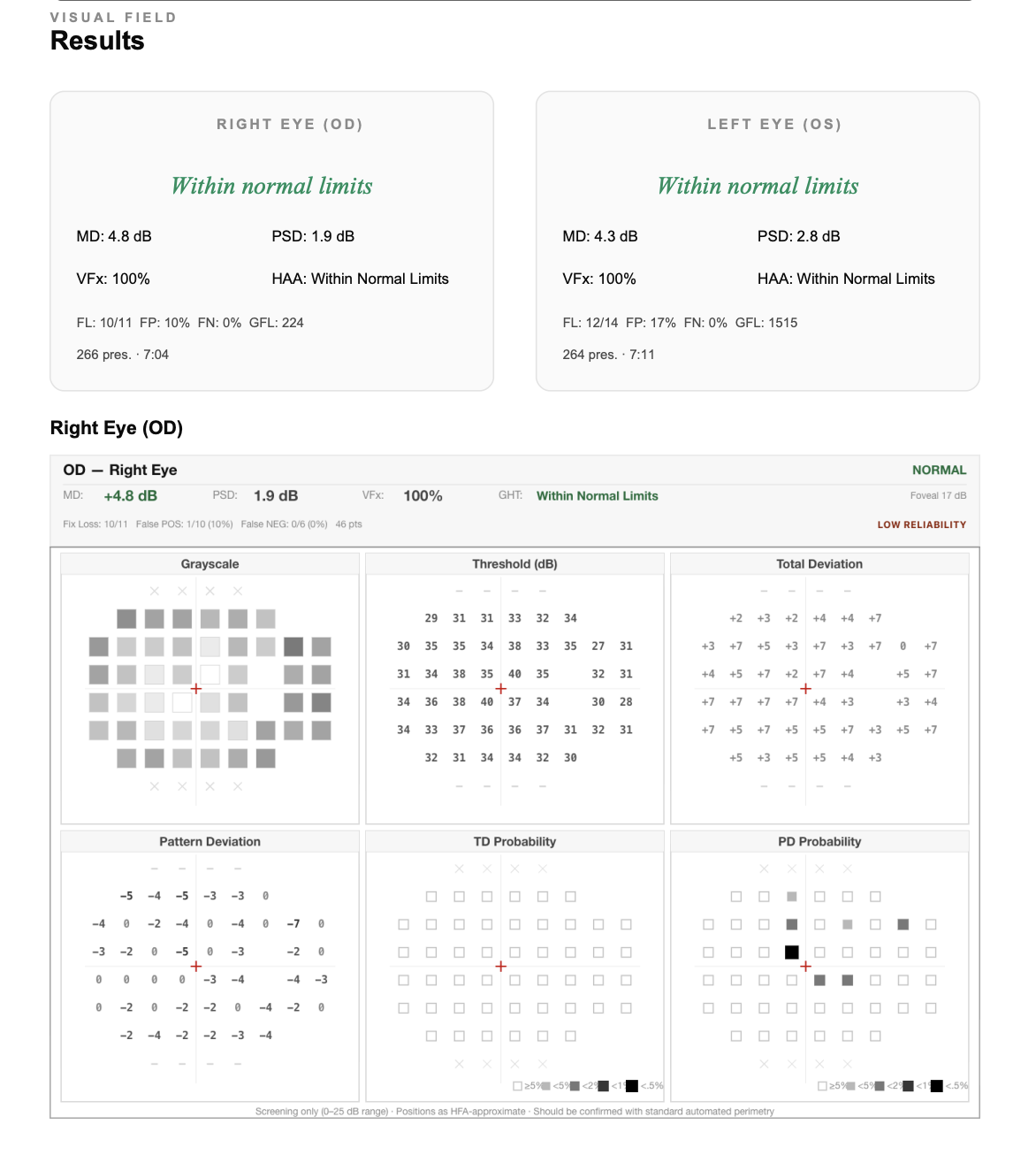
01 · Visual field

Catch the silent loss.

Peripheral-vision damage is the diagnostic signature of glaucoma — and the patient never feels it until 30–40% of axons are gone. A 24-2 screening grid done at home, voice-guided, reveals scotomas months before the next office visit.

Heijl A et al · Acta Ophthalmologica · 2009
02 · Visual acuity

Track central vision over years.

Glaucoma usually preserves central acuity until late, which is why acuity tracking matters: it captures advanced disease, comorbid cataract or AMD, and post-surgical recovery. ETDRS-equivalent Snellen, calibrated to the screen, voice-guided answers.

Bailey IL & Lovie JE · AJOO · 1976 (chart standard)
03 · Contrast sensitivity

The earliest functional signal.

Glaucoma damages contrast perception well before visual-field defects show up — patients describe lights as dim, halos around streetlights, struggling at dusk. A Pelli-Robson-equivalent test caught this years before automated perimetry.

Hawkins AS et al · Ophthalmic Physiol Opt · 2003
04 · External eye / surface

Drops fail when the surface is raw.

Chronic preservative-containing drops damage the ocular surface; the patient can't tolerate them, stops, and progression accelerates. Smartphone anterior-segment photos catch hyperaemia and blepharitis early so prescribing can switch to preservative-free before adherence collapses.

Baudouin C et al · Prog Retin Eye Res · 2010
05 · Quality of life

What treatment actually feels like.

The validated NEI VFQ-25 captures the functional impact of vision loss before structural tests catch up — driving difficulty, falls, reading speed, social withdrawal. Required by FDA for clinical-trial endpoints. Filled out every 90 days inside the app.

Mangione CM et al · Arch Ophthalmol · 2001 (NEI VFQ-25)
06 · Drops & adherence

The only lever that always works.

OHTS proved IOP-lowering halves five-year progression. Real-world adherence is ~50%. We schedule each drop, send daily check-ins via email, log every dose, and surface adherence trends to the doctor — turning the highest-leverage variable into a measurable one.

Kass MA et al · Arch Ophthalmol · 2002 (OHTS) · Friedman 2007
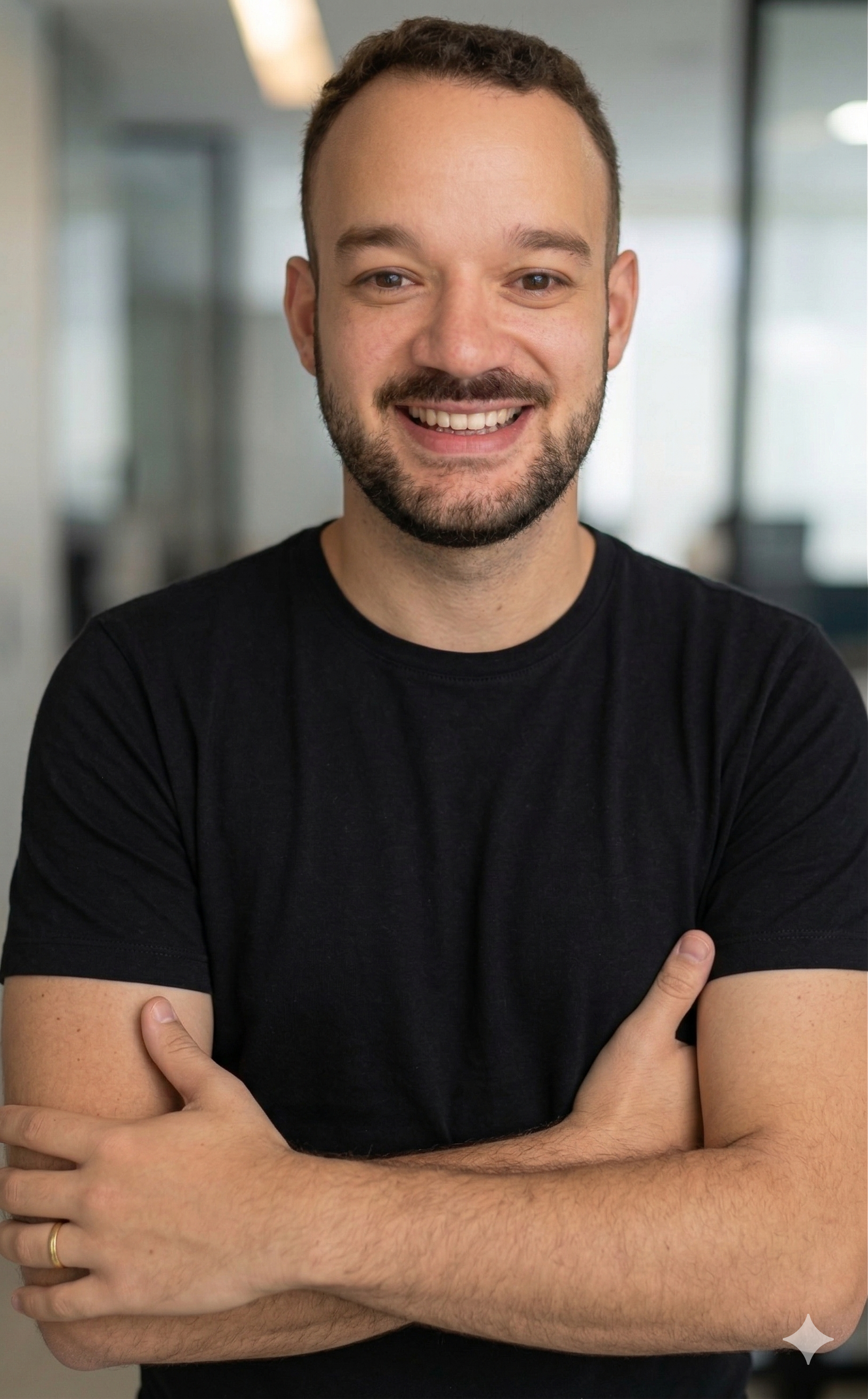
Mauro Gobira, founder of Glaucosim
From the founder

Built by an ophthalmologist who got tired of seeing patients twice a year.

"In residency I watched the same pattern over and over: a patient comes back six months later, the visual field is worse, and we're reacting to damage that already happened. The data was always there — it was just trapped between visits. Glaucosim is the tool I wished I had."

Glaucosim was founded by an ophthalmologist with deep clinical training in glaucoma management, in collaboration with a software team building voice-first medical interfaces. The platform is being prepared for its first clinical pilot at the Hamilton Glaucoma Center, UC San Diego — one of the most respected glaucoma research programs in the world.

Mauro Gobira Founder · Ophthalmologist
The platform

One product, two surfaces.

Patients get a quiet daily companion. Doctors get a longitudinal dashboard pre-sorted by risk. Both share the same data — only the lens changes.

For patients

Quiet, but persistent.

The disease never sleeps. Neither does the loop. A few seconds a day is enough.

Drop reminders by email — at your schedule, not ours 15-second daily symptom check-in Voice-guided visual field, acuity, contrast and anterior-segment exams NEI VFQ-25 quality-of-life questionnaire every 90 days Longitudinal trend visible to you and your doctor
For doctors

Triage, not triathlon.

Open the dashboard, see who needs you today. Skip everything else.

Patient list with risk pills (🔴 risk · 🟡 watch · 🟢 stable) Per-patient adherence trend, exam history and symptom diary Tokenised invitation flow — patients onboard themselves Care plans configured per patient (test cadence, medications) Anamnesis red flags surfaced automatically at intake
How it works

Three steps. No clinic visit required.

Doctor invites the patient

One tap in the dashboard generates a tokenised invite link. The patient receives it by email — no public sign-up, no insurance gymnastics.

Patient onboards in minutes

Glaucoma intake (diagnosis, medications, family history, current symptoms). Drops + schedule. Care plan created automatically with sensible defaults the doctor can override.

Daily monitoring runs in the background

Patient logs drops + symptoms. Scheduled exams come up when due. Doctor sees the patient list re-prioritise as risk shifts.

Pilot status

Launching at UCSD.

First clinical pilot under preparation at the Hamilton Glaucoma Center, UC San Diego — one of the world's leading glaucoma research programs. IRB protocol in development; data captured under HIPAA-grade infrastructure with a signed BAA.

Status Pre-pilot · Q2 2026
Site Hamilton Glaucoma Center · UCSD
Compliance HIPAA · Supabase BAA · LGPD-ready
Indication Screening adjunct · not a diagnostic device
Get started

If you're a doctor, your patients are waiting.

If you're a patient, ask your ophthalmologist to send you a Glaucosim invitation. There is no public sign-up — Glaucosim only works inside the doctor-patient relationship.